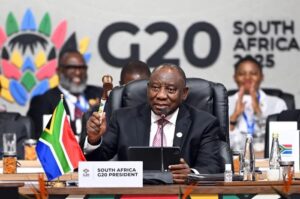
Will it reach the people or remain another well-worded promise?
The recent G20 Poverty and Food Security Declarations speak of urgency, inclusion, sustainable development and leaving no one behind. On paper, the intentions are powerful. The language is compassionate. The commitments are ambitious. But for those of us working daily in communities across South Africa, a hard question remains:
Will this declaration translate into real change for the people who need it most?
What the G20 Poverty Declaration Means
In essence, the declaration recognises that poverty is not only about income, but about access to food, education, healthcare, housing, dignity and opportunity. It commits member countries to:
Strengthening social protection systems
Supporting food security and nutrition
Investing in vulnerable communities
Empowering women and youth
Building resilient, sustainable economies
For organisations like Hope SA Foundation, this should mean increased support, stronger partnerships and better resourcing to expand grassroots work. In theory, it should open doors to funding, programmes and collaborative action that directly impacts families, children and communities living in chronic poverty.
Hope SA: Where Policy Meets People
Hope SA exists on the frontlines of poverty. It is here where declarations meet reality. Where meals are served, children are supported, and dignity is restored person by person. This is the real work of poverty alleviation slow, intentional, deeply human.
Yet, despite global commitments and national strategies, community organisations continue to struggle with:
Limited and inconsistent funding
Administrative bottlenecks
Unrealistic reporting requirements
Delayed payments
Constant uncertainty
The truth is this: while declarations speak of billions, grassroots organisations often operate on survival mode.
The South African Reality
South Africa’s poverty crisis is not theoretical. It is visible in:
Child-headed households
Rising food insecurity
Overcrowded informal settlements
Unemployment rates that crush generational hope
Communities dependent on overstretched NPOs
And alongside this is a painful, well-documented reality the diversion of funds, tender irregularities and corruption that erode trust and steal directly from the poor. This is not speculation. It is a systemic issue that has cost communities clinics, schools, food programmes and dignity.
The question is not whether funding exists. The question is whether it reaches the people.
Can We Speak About Corruption? Yes. We Must.
To remain silent is to become complicit. Speaking honestly about corruption, mismanagement and inefficiency is not negativity it is accountability. It is patriotism. It is protection of the most vulnerable.
But this critique must be constructive:
Not aimed at individuals without evidence
Focused on systems, not personalities
Rooted in solutions, not despair
What We Are Really Hoping For
Hope SA and many like it are not asking for miracles. We are asking for:
Transparent and traceable funding processes
Direct support to grassroots organisations
Simplified compliance systems
Real monitoring of fund usage
Community voices in decision-making
True hope is not found in declarations alone. It lives in implementation. In accountability. In integrity. In measurable impact.
From Declaration to Action
If the G20 Poverty Declaration is to mean anything, it must result in:
Food on real tables
Education in real classrooms
Support for real families
Opportunity for real youth
South Africa does not suffer from a lack of plans. It suffers from a lack of ethical execution.